A tour around Budapest’s hidden alcoves


One of Hungary’s foremost ceramicists, Margit Kovács (1902–1977) lived – like most people in Europe’s mid-20th century – in turbulent times. Born to a Jewish family in the city of Győr, Kovács converted to Christianity in the 1920s – something which undoubtedly saved her life during the horrors of the Holocaust and the Budapest Ghetto.
In fact, Kovács not only avoided arrest, but was feted and exhibited under Miklós Horthy’s fascist wartime regime. After the war she pivoted to the communists under Rákosi and – later – the more liberal Kádár in the familiar ideology-hopping dance many Hungarian artists of the era were obliged to do. This navigation of different political systems was not unusual, but affected the artist’s reputation in some quarters. In truth Kovács‘ work is largely apolitical, and the wistful, idyllic past it evokes was easy for any of the country’s governments to appropriate.
Kovács trained under Austrian ceramicist Hertha Bücher in 1920s Vienna and developed the nostalgic, decorative style that became her trademark. This style can still be seen in her many ceramic niches, built into the walls of Budapest’s architecture and surviving to this day.
Fishing Boy (14 Ponty utca, 1932)
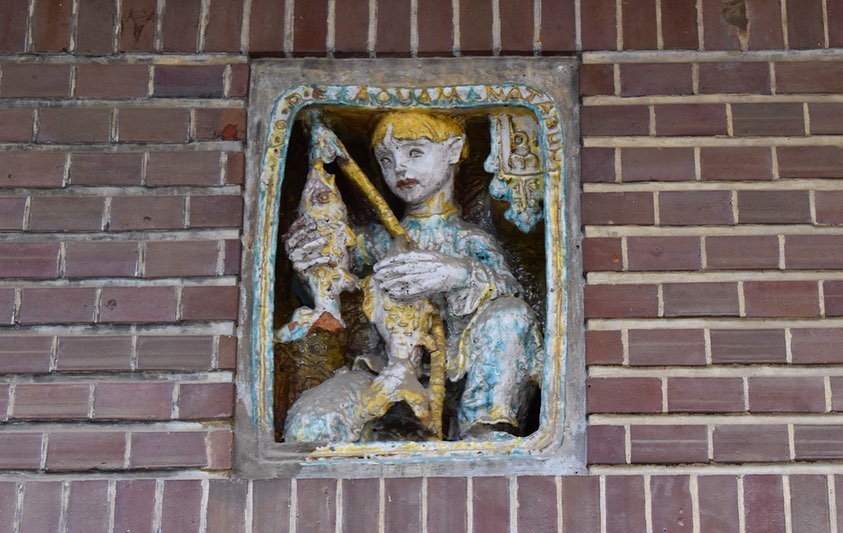
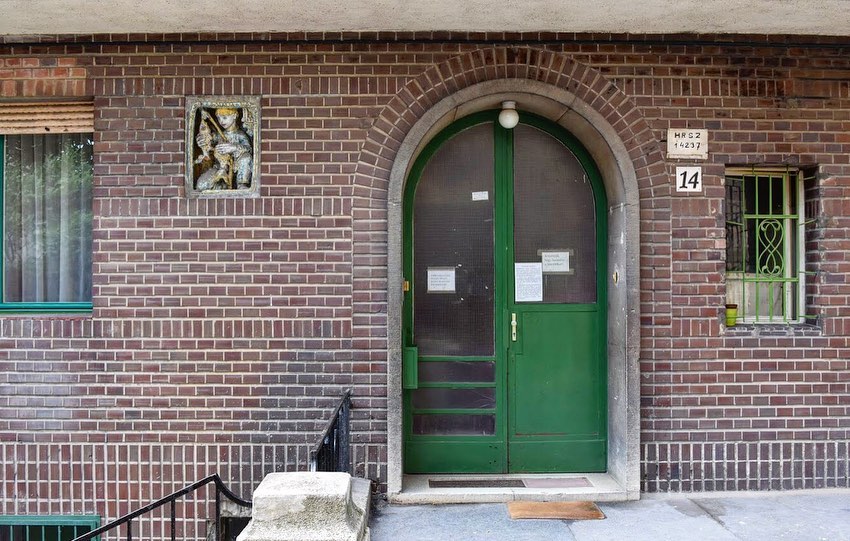
Possibly Kovács first public work in Budapest is Halászó fiú (Fishing Boy). The choice of theme is dictated by the location of the piece; Ponty utca means Carp Street. Although well-worn, this 90-year-old relief has managed to survive long into the 21st century.
Saint Florian (33 Katona József utca, 1935)
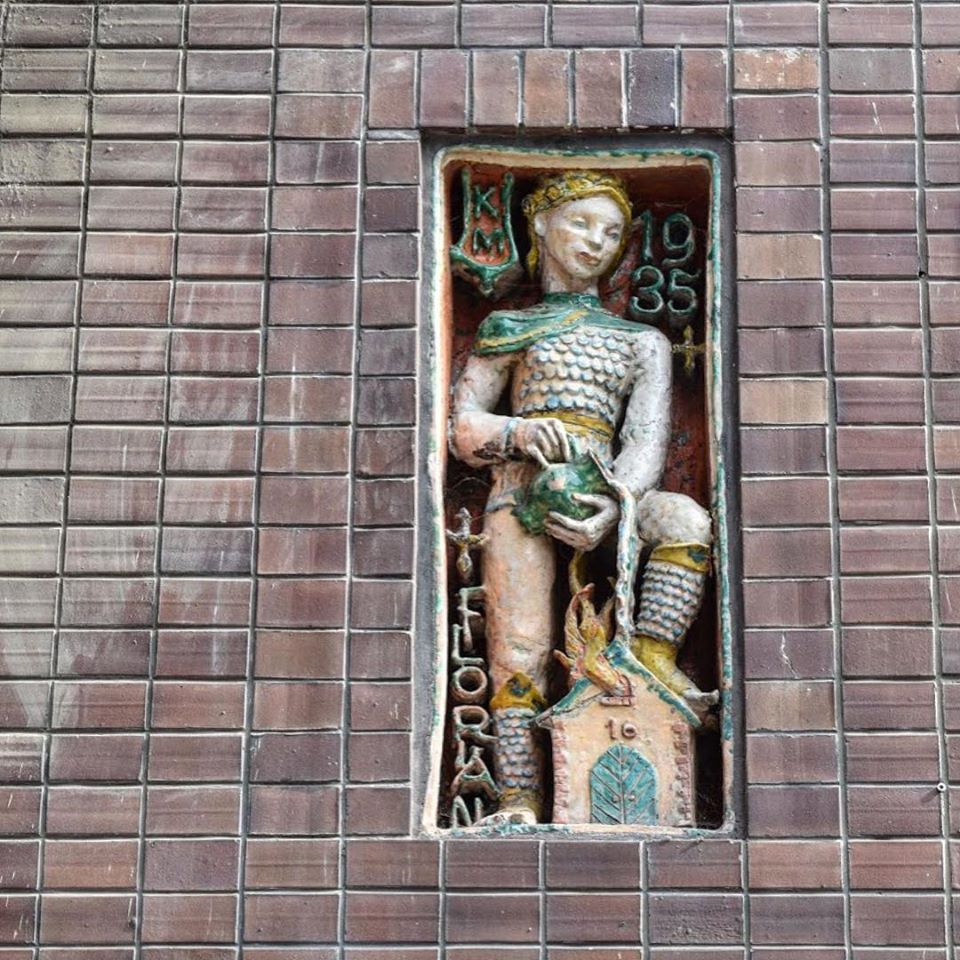

A tribute to the patron saint of firefighters (known as Szent Flórián in Hungarian), the location of this alcove – high above the pedestrians passing by – has largely protected it from damage. Florian’s fate was someone ironic given his later association with firefighters the world over.
The Old Post Office Sign (13 Régiposta utca, 1937)


Second image courtesy of Wikimedia Commons
A few years later Kovács produced a sign commemorating Budapest’s old post office, depicting the mail carriage complete with laughing riders. One of the most heavily damaged of the surviving works, it still retains its charm.
A Peacock Took Its Perch (15 Vármegye utca, 1939)


Demonstrating that Kovács kept producing public commissions right up until the dawn of World War II, Felszállott a páva dombormű (roughly translated as “A Peacock Took Its Perch) is based on a poem from the great Endre Ady. It can be found high above your head on Vármegye utca in District V.
Madonna and Child (18 Tárnok utca, 1974)


A much later work (there were others made in the meantime but they reside in institutions, not outside and publicly accessible), Madonna and Child (Madonna gyermekével) can be found in the popular Castle Hill district above the Arany Sas Phamaceutical Museum.
The Siege of Buda Castle (Ostrom utca, 1977)

Finally, The Siege of Buda Castle stands outside the famous Vienna Gate at the entrance to Castle Hill. Perhaps the most complex and ornate of Kovács‘ public works in the capital, the niche depicts the recapture of the castle from Ottoman forces in 1686.
 East of Huntcliff