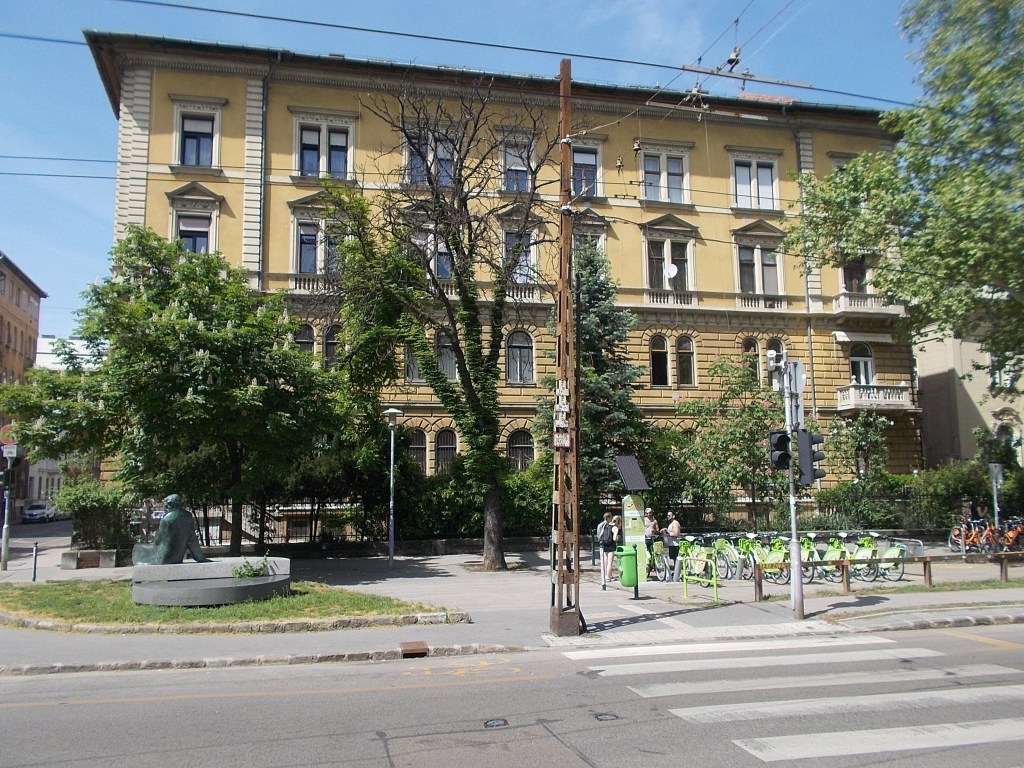
While working in Budapest I was lucky enough to live in a 100-year old building at 1 Felsőerdősor utca. I know it was 100 years old because I woke up one morning, went outside to water my plants on the 3rd floor balcony, and was faced with 20-odd older folks milling around amongst my tomatoes.
This turn of events came about due to the wonderful Budapest 100 scheme, where a building that’s hit its century that year is opened to the public for a weekend. Thankfully they were only allowed in the central courtyard and balconies, and not actually in the apartment itself.

Like most old buildings in central Budapest, 1 Felsőerdősor utca has had its share of notable inhabitants. There’s a sense of the decades stratified through apartments that have seen many wars, uprisings and revolutions (evident in the potholes in the brickwork of many buildings) and – curious as I was – I spent a week during lockdown researching the previous occupants. Here’s what I found.
A Patriotic Sculptor

First up is (of course) a sculptor. Károly Fleischl (1866-1946) designed parts of both the Budapest Basilica and Hungarian parliament building, as well as creating the first public statue of national hero Kossuth.

Fleischl was presumably Jewish, as the Holocaust Survivors and Victims Database lists him (by then living at 5 Bela Somogyi utca, close to the Jewish ghetto) as a survivor of the Holocaust. His death one year after the war suggests he was a survivor in name only.
According to an interview with his son, Fleischl spent many of his days at the Cairo Cafe on Lövölde tér (right next to the building). When we lived there it had only a children’s playground and a (very good) kebab hut.

A Wasted Operatic Talent

Lilla Lindner (A.K.A. Károlyné Fleischl, 1876-?) was a trained opera singer. She was married to Károly Fleischl.
Although she never achieved huge fame during her career, Lindner performed at the Budapest Opera House, and once took the starring title role in Carmen.
Like many women of the time, her career ended when the couple got married in 1898 – a depressingly predictable state of affairs. According to her son she took up handicrafts after her retirement from the stage and often played piano and sang at home (although the piano was once sold to pay the couple’s increasing debts after the financial crash).


An Erotic Poet

The next inhabitant I came across was Renée Erdős (1879–1956), a poet who explored female sexuality and was one of the first Hungarian woman writers to make a living from her writing. In an era of strict public morality, Erdős wrote openly about orgasms and menstruation.
Erdős – like the Fleischl family – was Jewish, as were many of the building’s other notable occupants during the late 19th and early 20th century.
A contemporary description of her work reads: “Renée Erdős is, in the poetry of the new age, a phenomenon. [her work exudes] a freshness that is almost alive, that bleeds and blazes, is stamped the mark of a work which will last.”
A Maestro

Antal Fleischer, a composer and conductor (for the Budapest Folk Opera no less) who lived there from 1919 to 1945.
I’m looking at that date of death with a bit of dread given his Jewish roots. There are stolpersteine (stumble stones) outside many houses in Budapest, commemorating Jewish people who were murdered during the war. While there are some outside other buildings on the street, there are none outside this one, so I can’t say with any certainty.
An Elusive Painter
Painter Gabriella (Keá Lórántné) Fáber (1903–1982) also lived and died in one of the building’s apartments, as evidenced by this plaque on the wall outside.

Below is one of her paintings, I don’t have much more info in English besides that her work can be found in the Hungarian National Gallery and that she exhibited in West Berlin in 1974, which is interesting given the political climate of the time. A few of her other paintings can be found for sale online.

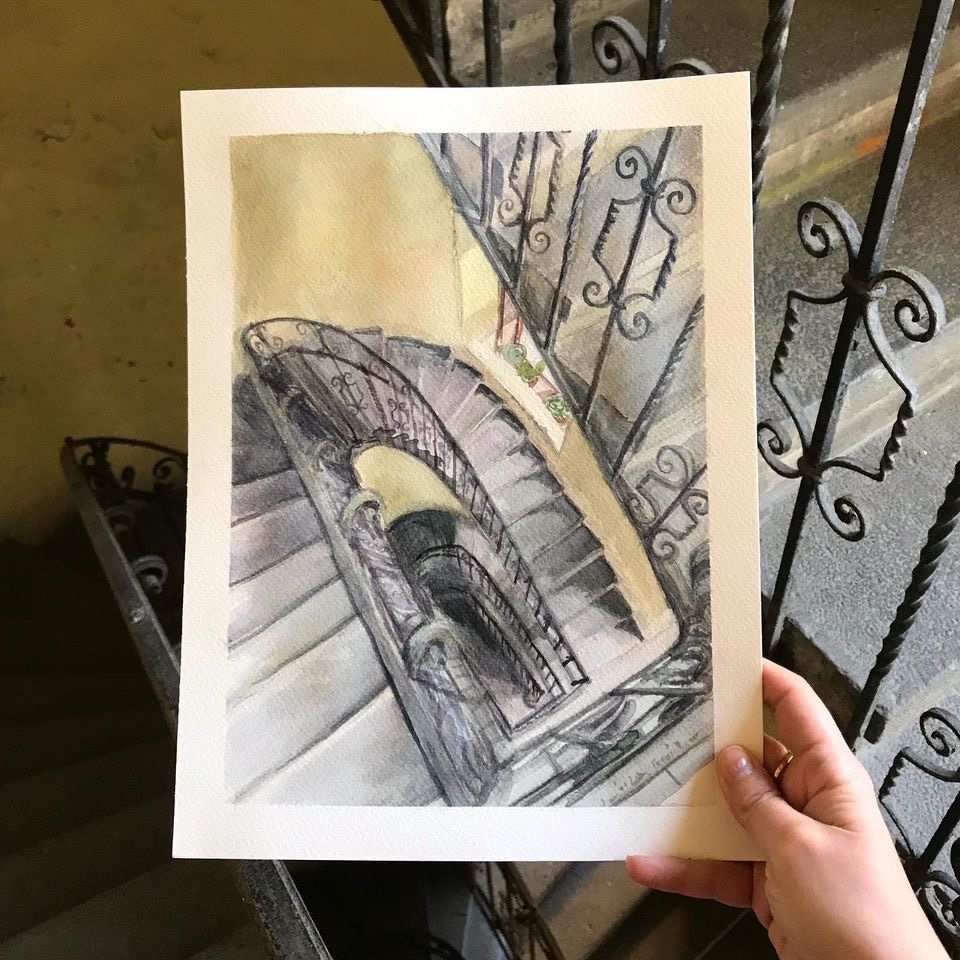
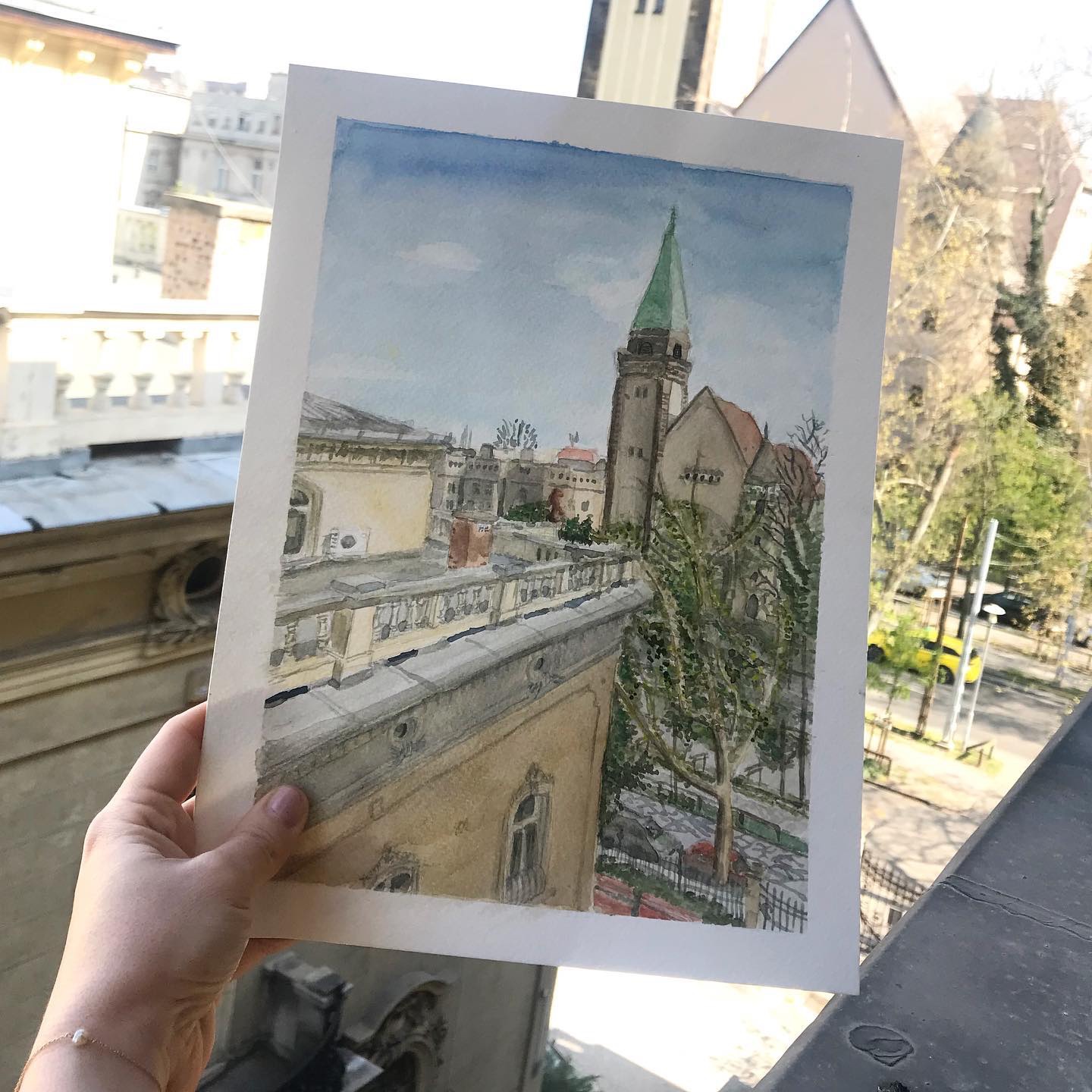
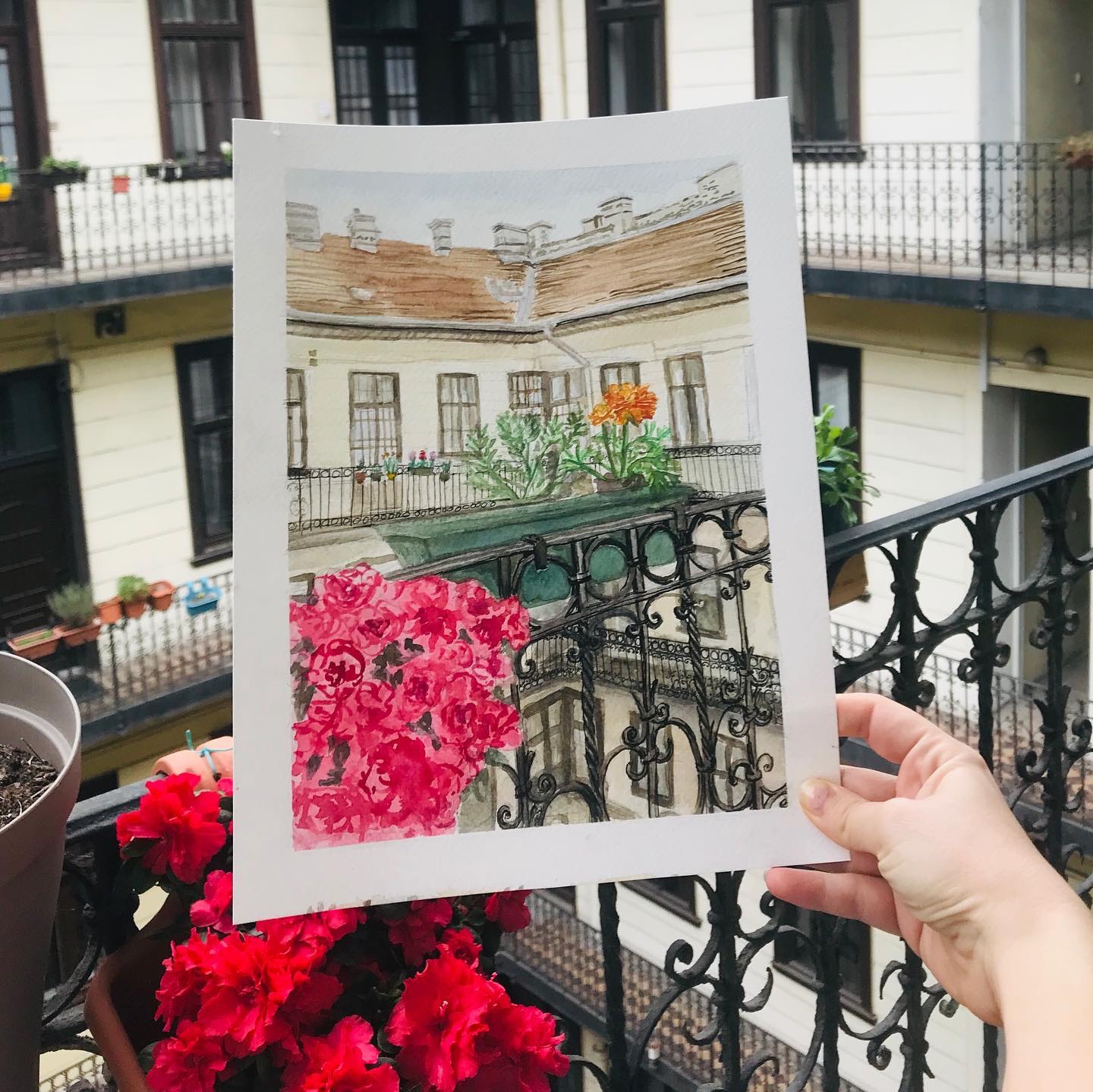
And last but not least, my very talented wife Jenine Sharabi, who painted a series of lockdown scenes from in and around the building at the beginning of 2020.
 East of Huntcliff